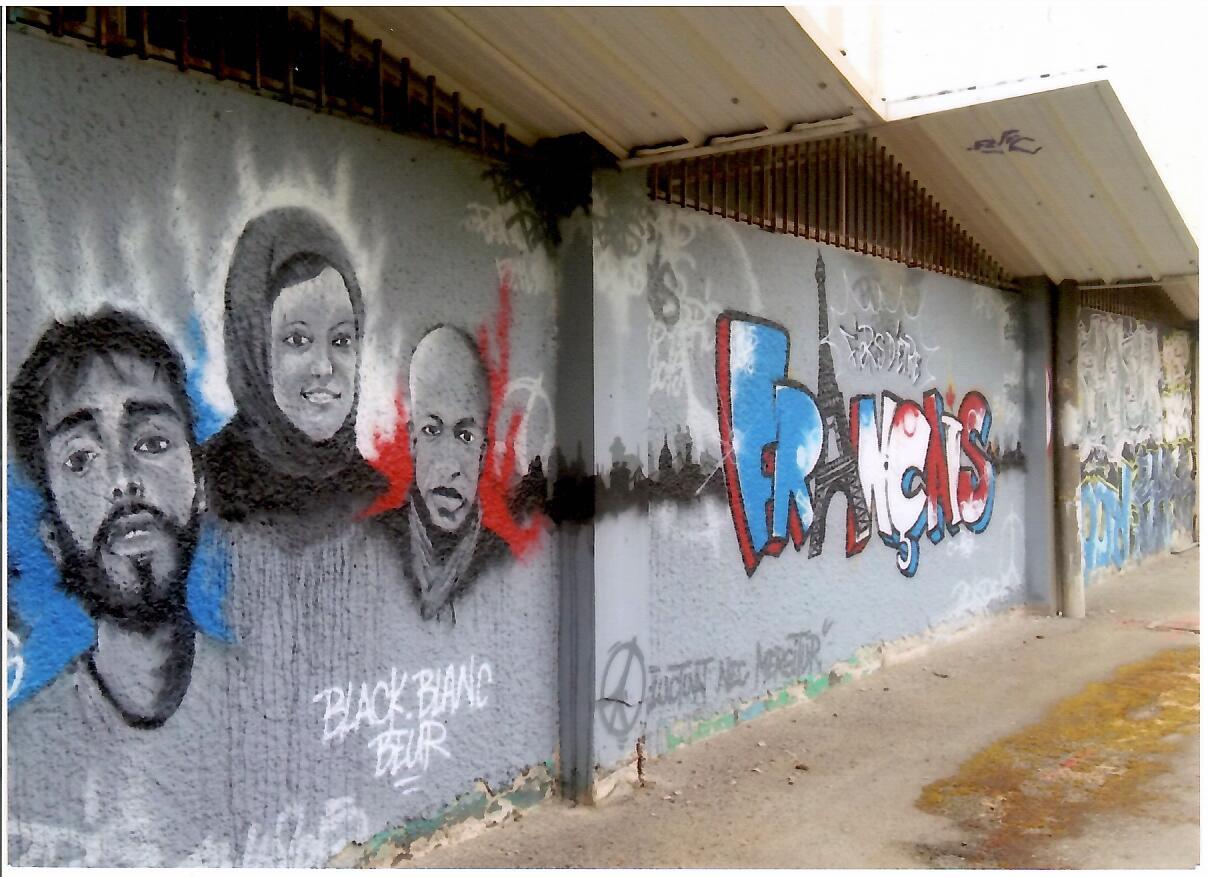
Yesterday I asked the question: Why do I feel American despite having no native American blood, whereas Khadega, with no native blood of the country where she was born, doesn not feel French?
A part of the answer is because of the messages given to us. What we are taught in school, from the government, and the media in general.
In American public schools we are taught that American history is all of ours, collectively, as a nation. We are taught this whether or not our families immigrated recently or were early pilgrims. That said, I did not grow up in a community with many native Americans. I wonder how they experience history class!
First generation children of European descent feel that same collective White embarrassment that the descendants of planatation owners feel regarding slavery, even though their families weren’t in the country when it happened. The same goes for the American Revolution. We are taught to see the British as the “bad guys” whether or not our family fought in the war or was even in the country at the time.
In French public schools, the non-White students, born in France, often times to parents who were also born here, are refered to as “immigrants” who must learn to “integrate.” There are special classes put in place which are understood to target non-Whites, although this is not stated officially. These classes are said to teach republican values (valeurs républicains) and secularism (laïcité). (The concept of “laïcité” is a vast exhausting one full of hot air that I should treat on its own in the future. The same goes for the very elusive: “valeurs républicains.”)
Interestingly, a distinction is made for the descendants of immigrants who look White. For example, France has a long history of immigration from Spain. The family names Garcia and Jimenez are commonplace here. And yet, these lighter-skinned descendants of immigrants are treated like any French person. Their children are not branded unintegrated, like the dark-eyed Algerian, the dark-skinned Senegalese or Cambodian with epicanthic eyes. The later three are systematically questioned, right after the first Bonjour, about their ethnic background. I hear it all the time in the question, as common as the handshake in America: “What origin are you?” (Vous êtes de quelle origine?)
It seems that denying non-Whites a national affiliation is not unique to French society. The Irish author, Roddy Doyle wrote a short story on the topic, titled “Back to Harlem.” It introduces us to Declan O’Connor, the son of a White Irish mother and a Black American G.I. who is raised in Dublin. He says that in America it is different. In America, everyone is American. One may be Asian American or Black American or Native American, but they will always be American. Declan’s character explains that in Ireland, however, he will never be accepted as a true Irish person because of his dark skin.
After long reflection, I have come to understand the American concept of identity as the following. There isn’t one. I mean there isn’t ONLY one. We have two identities. A national one, which is based on where one is born; but also an ethnic one, based on one’s genetic make-up. This is why I can feel American although my ancestors came from Ireland and Iran. My physical appearance does not determine whether or not I will be accepted as an American by my peers. Whereas Khadega will never be seen as truly French.
For an American there is no inner conflict. Depending on context, we identify with either our nation or our ethnicity. Should an American find themselves shopping for make-up, the phrase: “Orange lipstick looks good on me because I’m Polynesian,” does not mean that that same person doesn’t celebrate as an American on the 4th of July. The former situation pertains to their ethnic identity while the later applys to their national affiliation.
Practically speaking, in a country where the great majority of natives were exterminated and the invaders’ progeny has multiplied and become the majority, how could things be organized otherwise? The great challenge of the rulers of the U.S.A. was to figure out how to create a feeling of common belonging amongst a vast group of different peoples. The French rhetoric of “you are not French if you are not white” cannot work in the U.S.A. Ever go to a Pow-wow? The U.S. government even wants the true natives of this land to feel American and to show that they are okay with the current power in charge.
Even though, I am appalled by how my nation was founded and by how it developped its industries. And even though I know that while we teach non-Whites that they can be American just like anybody born here, only to discriminate against them in other ways, I still see something positive as opposed to what I witness here in France.
While a non-White in America may be denied many things, s/he will at least not be orphaned. Stripped of a national identity. At least they can have some kind of footing where they were born. I can hear the ring of the idiom “bloom where you are planted” resonate in this idea. The patch of earth that one American is born on may not be as nice as where another ends up but at least they get some earth at all.
 Pardon My France
A very thoughtful piece, Mecca. I’m so happy learning how you view yourself in France, compared to in the U. S.
For expats living in Cuenca, Ecuador, we dread being labeled as gringos with mucho cash.
It’s an experience we never feel in the U. S.
LikeLike