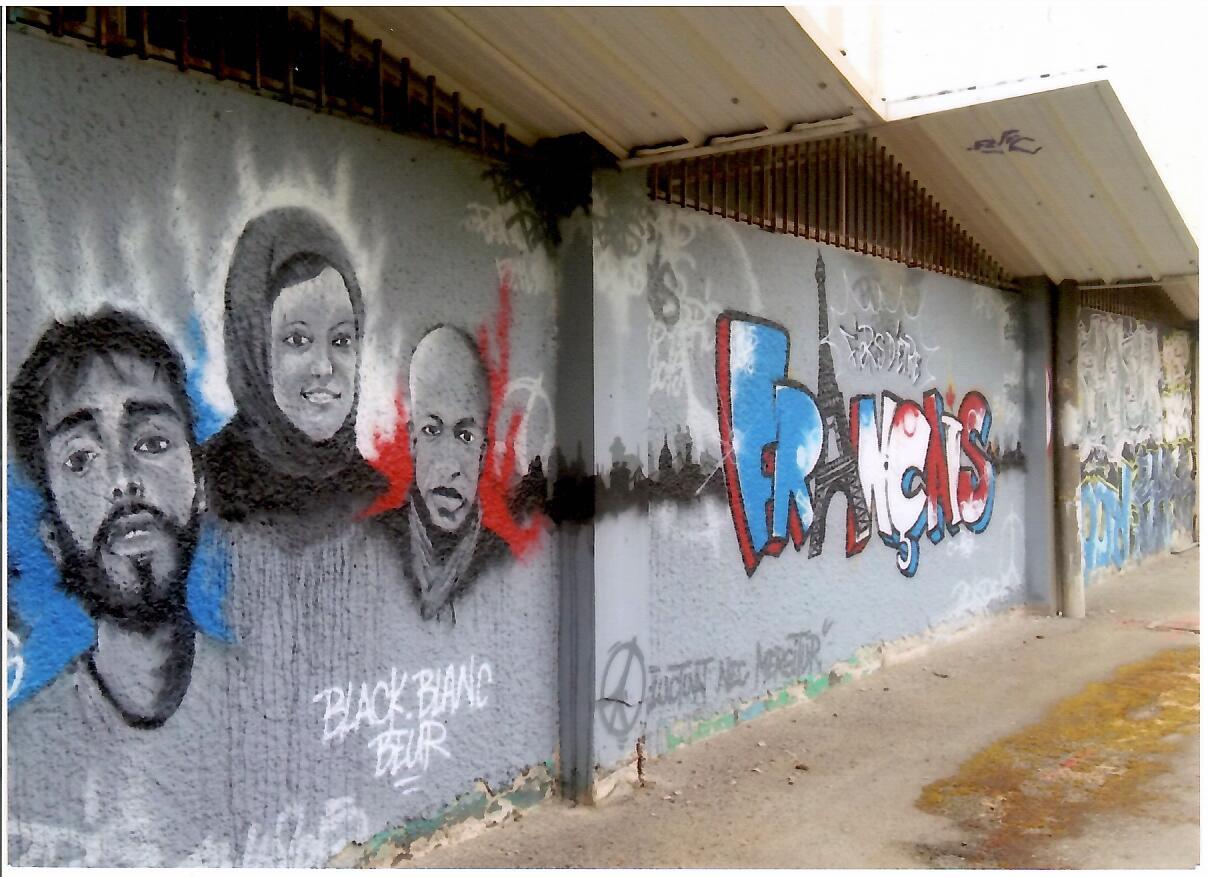
In my home country we say that “a picture is worth a thousand words.” Concerning, the above photograph, “Black, Blanc, Beur,” that expression is an understatement. When I look at it, words enough to fill an entire book fill my mind. So I can certainly fill a blog! Today, on the 25th hour of 2022, it begins.
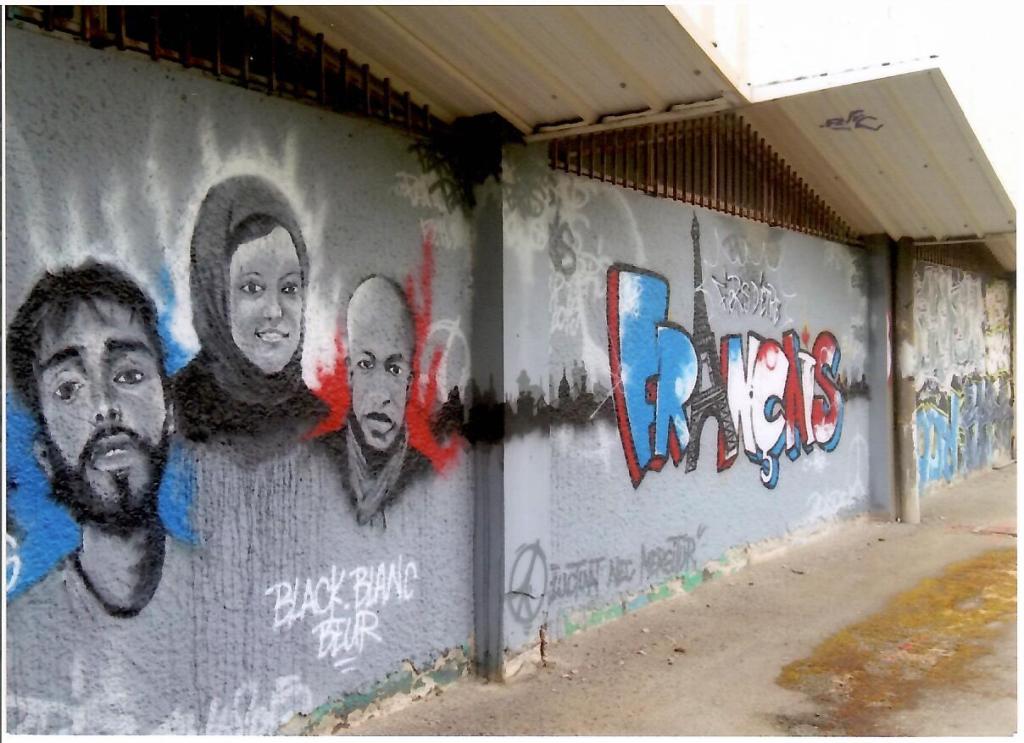
What you see above is a photograph I took of graffiti art done on the back wall of a minimart in my neighborhood. The colors: blue, white and red were used because they are the three colors of the French flag. Did you notice the Eiffel Tower? Due to its triangle shape it was used to substitute the first “A” in the word “Français,” which translates as “French.”
We also see three young people, underneath whom, the inscription “Black, Blanc Beur” is written.
“Black,” refers to people of Sub-saharan African decent.
“Blanc,” which translates as “White,” refrers to Europeans.
“Beur,” refers to those of North African and Arab etnicity.
And, yes, those three words starting with the letter “B” refer to the ethnicities of the people painted above it. I’ll let you guess which B-word is linked to which portrait.
So why would an artist choose to combine these words and imagery?
The artist is expressing their opinion on an on-going debate in France: What does it mean to be French? This debate has nothing to do with what one’s legal documents say, like a birth certificate or passport. It is refering to the popular idea. How people in society define what it means to be French.
My personal interpretation is that the artist is saying that a person does not need to be White to consider themselves French; even though, France, a country of Europe, is populated by mostly Whites. A person can be viewed as French regardless of their ethnicity, be it Black or Blanc or Beur. (And I am sure that s/he would agree that the same goes for any other ethnic group.)
It is also important to note that this debate can include non-Whites who were born and raised here in France, as well as second generation and even farther back.
Does this debate seem strange to you? It certainly did to me when I first came to France.
My first memory of it occured on a Parisian subway car, zooming by countless walls of graffiti. I was sitting with a French friend of Arab descent, named Khadega, and a White American friend, named Melissa, who was visiting me from the U.S. Somehow the topic of racism came up. In a perfect local accent, my French-born friend said, ” I don’t identify myself as French. I don’t feel French.” Melissa and I, both born in the U.S.A., looked at eachother, puzzled. “I am German and Italian,” said Melissa, but I feel American first. “I feel, American, too,” I agreed, raising my Azeri-Iranian eyebrows and rubbing my knoby Irish knees.
It took me a long time to understand why someone who was born here and hence speaks French like any national wouldn’t identify themselves as a French person. It has taken me years actually to fully comprehend it! In the end I have come to understand that what I feel as an American is unique. Our view as a national collective is that if you were born in a country and speak like the people from that country then you are From there.
So then how is it that Khadega doesn’t feel that she is a part of the country where she was born, but I do. I am not native American, like Khadega is not native French; and yet, I feel a part of the country where I was born, but she does not.
I’ll let you reflect on that and I will continue with Part Two tomorrow. (And this topic may well reach one thousand words.)
 Pardon My France