True Toulousain. True French.

Over the past few weeks you’ve read plenty about me. Now it’s time to meet my neighbors.

I live on the fifth floor of an apartment building in the fourth largest city in France, Toulouse. I share my floor with four other families. Seeing things through the eyes of a Toulousain (inhabitant of Toulouse) I’ll introduce you to my neighbors and describe how a Toulousain brain might categorize them nationality-wise upon first view. I will also give you their first names and approximate age to make them easier to imagine. Then I will give you my opinion on what I see, which, of course, I consider more accurate.

Father and Son Apartment:

Name: Dider (father)

Approximate age: 58

Skin color: fair

Nationality: French

*

Name: Julien (son)

Approximate age: 20

Skin color: tan

Nationality: Immigrant French, by his mother who must be African or Arab

In reality, in my opinion, Didier has olive skin as is common to this region of southwestern France. His European features make his skin appear fairer than it actually is. His family has been in this region for a long time. He is not originally from Toulouse but his parents and grandparents come from a small town, named Rodez, which is not too far.

Julien, his son, is mixed. His mother is from Africa, but I do not know which country.

Retired Couple Apartment:

Name: Fatima (wife)

Approximate age: 67

Skin color: tan

Nationality: immigrant from North Africa

*

Name: Rasheed (husband)

Approximate age: 72

Skin color: tan

Nationality: immigrant from North Africa

In reality, these two have olive skin, like Didier. They were both born in Algeria from which they immigrated to France where their children and grandchildren were born. All three generations of this family are considered immigrants in the French psyche.

Nuclear Family Apartment:

Name: Vérionique (wife, mother)

Approximate age: 43

Skin color: fair

Nationality: French

*

Name: Sebastien (husband, father)

Approximate age: 43

Skin color: fair

Nationality: French

*

Name: Emma (daughter, sister)

Approximate Age: 17

Skin color: fair

Nationality: French

*

Name: Nicolas (son, brother)

Approximate age: 15

Skin color: fair

Nationality: French

My first long conversation with a neighbor on my floor was with the wife/ mother of this family, Véronique or Véro for short. In France, if you have a foreign accent (like me) or if you do speak like a native (even better than a native) but do not have fair skin, you will almost always be asked from whence you came. Véro was true to that claim. Also typical, was her surprize upon learning that I was not North African. However, explaining to her that I was American was not enough. Because, as is assumed by most of the world outside of the U.S.A. and thanks to the great Hollywood distribution machine, we Americans are assumed to be « White. » So if you « look Arab, » like me, but say you are American, people’s brains start to bug. They usually are too embarrassed to probe further, but not all of them. This is the case of Véro who continued to make inquiries. The obliging, polite suburban American female that I am, I went on to reveal my ethnic background which explained why I didn’t look 100 % White. Upon hearing that I was Iranian and Irish she was satisfied. Afterall, Iranians are just like the Arabs, right ?! Irish, though…she did NOT expect that ! And how interesting (to her) that her sister emmigrated to Ireland !

Having nothing else to extract from me, Véro switched the topic to gloat about herself. « I’m a true Toulousain, » she said with obvious pride. « My husband is a ‘vrai Toulousain’ too. »

They were both born in Toulouse. Met in school in this city where they were high school sweethearts and the fruit of their relationship delivered two undeniably authentic Toulousains!

I was impressed, I guess.

No. I don’t care. Not really.

I could only think of how if she had tan or brown skin that she wouldn’t be considered a « true » Toulousain despite being born here. She wouldn’t even be considered truly French.

But then, without her realizing it, she really made my day…

Caught in the romance of where she came from she went on to elaborate. As it turns out, Véronique actually has ancestors from Spain and Corsica (which became French only in the18th century). Her husband, isn’t exactly French either – but don’t tell her or him that. He has family roots in Spanish Catalonia.

I wanted to…yes, I wanted to say it out loud…but I just chuckled to myself on the inside. Thinking, « I thought you were a true Toulousain through and through ! » I am used to this kind of talk and I avoid getting into futile debates with people who do not know how to listen to anything other than the endlessly repeating chorus in their head. That is unless I have extra time that day by chance. But, I generally put my energy where it is most useful because it is limited. Or maybe it’s because, again, I am a product of suburban America, where a girl is supposed to be polite and only say nice things.

Mother and Son Apartment:

Name: Marie Hélène (mother)

Approximate age: 58

Skin color: fair

Nationality: French

*

Name: Quentin (son)

Approximate age: 22

Skin color: fair

Nationality: French

In reality, this mom and son duo is just as French as the nuclear family. On one very chilly winter’s day, while chit-chating with Marie Hélène she said, « I can’t take this cold. I’m Spanish. » (There have been several waves of immigration from Spain into France, especially here in the southwest. We are on the other side of the Pyrenees that separates the two countries.)

In conclusion, should I use the popular French idea that a person is only truly French if they are perceived as White and if their family has been on French soil for as long as can be remembered then there is only one true French person on my floor. That would be Didier, with the Southern French olive skin, divorced from a woman from Africa; and who has, as far as I have seen, only ever dated women from Africa since.

A True Aryan

Last week I talked about my eyes. This week I will tell you about my skin.

Where I grew up in America there were mostly White people of Irish, German, Italian and Polish descent. It was made known to me that I looked different than them. My skin was not the same as theirs. It was told it was olive, while theirs was fair.

As a teenager in Egypt, I attracted a lot of attention in the street from young boys because of what they called my “white skin.” All of the sudden, in Egypt, even though I still remained a minority, I had become white-skinned and the majority was now those who had olive skin.

In France, no one has ever told my that I am tan-skinned. I think they see my skin tone as similar to their own. That said, I live in the south of France, along the Mediterranean sea. Just on the other side of that sea is Africa. Here, we are closer to Algiers than Dublin, at least as the black crow flies. This is the true home of olive skin. We’ve even got the olive groves to go with it. However, the locals don’t like to talk about that. They think they are just as fair-skinned as any European.

In my 30s, I did some research on the man from whom I inherited this skin, my father. All I know about that side of my family is the little that my mother has told me. It turns out that even in Iran, my people make up a minority group. My father is Azeri-Iranian or Turkish-Iranian as he prefers to be called. In public he speaks Persian like any Iranian, but at home, with his family, he speaks a tongue closer to Turkish.

This minority of Iran originated from Azerbaijan and lives mostly in the northwest of the country along the Caspian Sea. Also near the Caspian Sea is Caucasia, a region home to the Caucasus Mountains. We (the Northern Iranians) share these mountains with the Armenians, Artsakhis, Azerbaijanis, Georgians, Kurds, Southwestern Russians and Eastern Turks. All of these peoples are Caucasians as far as our world topography is concerned. Yes, Caucasians !

So, now, who’s White ? And who’s Caucasian ?

Rock your world ? It certainly, did, mine!

Get ready for another idea about « White-ness, » to be shaken up, that us Westerners think we understand without fault.

Do you know what an Aryan looks like ? Blond and blue-eyed ?

Nope.

I discovered that « Aryan » denoted someone from Iran in ancient times. They called themselves Aryans and everybody else in the world were the non-Aryans. The word « Iran » is even derived from « Aryan. »

So, as it turns out, this skin of mine….no, it isn’t White. It isn’t even olive or tan. It’s historically, Aryan and has always been Caucasian.

This skin of mine, is fair, but not like a European’s. Maybe some White people can relate when I write that I avoid wearing shorts in the summer because the skin of my legs (that hasn’t seen sun all winter) just looks too ghostly. I’m not talking about those Northern Europeans who have that grayish hue to their skin. I mean it’s moreso translucent – like you can almost see my veins.

The rosiness of my cheeks and lips, however, is a very common sight and all year long. But unlike some Northern Europeans the pinkish-red only accents those mentioned features – it does not spread all over.

In the sun, my epidermis does not burn. It barely even tans. I would love it, but I do not have that southern European skin that tans up quick and golden. Like some Asians – because yes, Iran, is a part of that continent – it does tan eventually, but only after a lot of sun exposure.

*

I recently went to visit a cousin who is a very cultured person. Being with him is like hanging out with a walking breathing encyclopedia. So, I was sure he would be amused by what I had learned regarding my Caucasian skin. I explained to him how I have been mistakedly called olive-skinned my whole life. How when I was a kid, uneducated on my own ethnic heritage, I took what outsiders said to be the truth. I further explained to him how I came to understand that people see my dark eyes and dark hair and their brains fill in the rest. They are used to associating such dark locks and irises with tan skin so they stop seeing me and let their imagination overpower reality. As I said all of this, I was passionate. I was convincing. I told him about the Caucasus mountains and the Aryans. So, I knew that he would be ready to answer correctly when I asked him : « So you, what color do you think my skin is ? »

He considered my question thoughtfully, looked straight at me and said, « you’re olive-skinned. »

The Wrong Kind of Eyes

I woke up this morning with what looked like the beginning of pink eye. So to “kill it in the egg” as the French say, I applied antimony powder or kohl to my eyes. It is essentially worn as make-up but my use of it this morning, was for its more practical attribute – the antiseptic one. (Note, most eye makeup being sold as kohl isn’t actually the true mineral antimony. So just go to the doctor if you get conjunctivitis.)

*
I first discovered kohl in Egypt when I was a teenager, watching in amazement as a woman seemed to be poking herself in the eye with a toothpick sized stick, covered in black powder. One eye after the other, she pressed the stick between her upper and lower eyelid, squeezing them shut, but leaving just enough room to be able to glide the tool through, disposing silky ebony black antimony powder along the rim of both upper and lower lids simultaneously. A gesture done with such ease that it was obvious that she had inherited it from generations of women who’d done the same. Of course, doing it every morning will also make it look like child’s play.


I, too, have mastered the technique, but I don’t wear kohl every day. Only when I am in the mood. For example, when I look tired, I’ll put it on to “brighten” up my face. And by brighten up my face I mean, the only part of me that will be glowing or standing out are my eyes!


Sometimes after just waking up, I look in the miror, see my reflection, and I think, “Hmm. You kind of look White today.” Something about rest softens the top half of my face. And then I start to wonder if there are any O’Canainns that I resemble in that moment. Most of the time, though, I don’t see anything Irish about my face at all. I certainly have my father’s broad forehead and his deeply set orbits to go with it. Once, I outline those deeply set eyes with kohl any hint of Ireland washes away. And I could be just as much a twisted Orientalist’s fantasy as would be any full-blooded Middle Easterner.


So, I have this possibility, you see, to “intensify” my gaze or keep it “neutral.” I would even say, I can make myself look more Middle Eastern or more European. Again, it all depends on my mood. I’ll wear kohl when I feel washed-out or sometimes just happy. Or maybe when Norouz time (Iranian New Year) is on its way, or if a lot of racist propaganda has been circulating and I’m feeling defiant. Or, on very rare occassions, I wake up to pink eye.


There are also times when I will refrain from using kohl. These include situations where I have to do complicated administrative paperwork and don’t want to make things any harder should I come up against a racism. For example, I did not wear it when I went for my French naturalisation appointment. The appointment went well. The interviewer even managed to hit on me and make a racist remark about “certain lazy free-loading foreigners” in the space of five minutes.


In the early 2000s, in France, my family was looking for an apartment. Mohamed suggested I go alone to meet the realtor giving the follwing reason: “The French don’t like to rent to foreigners, but they like Americans more than Arabs.” I did not wear kohl. We got the apartment. It had the best view of any appartment I have ever lived in. 11th floor. We could see the city unfolded before us like a map. Even saw airplanes taking off from the airport in the bordering town. Unfortunately, it was infested with cockroaches.

*
When I was a teenager in the U.S., I got free samples of colored contacts. Initially, I had just wanted to try them for fun, but seeing myself with lighter eyes had an unexpected effect. For the first time in my life, I looked like my family. Blue-eyed, like my maternal cousins. It felt incredible. It felt like “belonging.”


To belong. That’s what a lot of people want. I met someone who sought that at work one day. One of my students. He was a seasoned make-up artist with a Parisian accent dusted with something “not quite.” He seemed like a nice guy, genuinely well meaning. But he had been trained in the European make-up industry and now in his fifties, mainstream beauty standards were well anchored in him.

As he was a nice guy he offered me a customized beauty tip: “You have severe eyes. You should wear green or blue eyeliner and eye-shadow to make them less “aggressive.”


He must have noticed my smirk because, again, as he was a nice guy, he went on to sympathize with me, explaining how he too, had “the wrong kind of eyes.” He went on to explain how people with epicanthic folds like himself had to use make-up to make their eyes look bigger as they were “too small.”

Wow!

*
When I first arrived in France, and wasn’t as used to being the target of violent racist media, I remember feeling out-numbered and unsafe. The finger-pointing at Arabs (or anyone who looks Arab) and Muslims felt so strong that I couldn’t help but think of France’s Nazi past. I would joke, with a chuckle to cover my fear, about Muslims being made to wear badges the shape of crescents.


It is during this time that I experimented with colored contacts for a second time. Only this time it was not for fun. I tried a few colors, keeping the one that looked the most natural and passed me off the best as a White girl should ever I need to blend in to protect myself. Dark green was the best color for that.

Afterthought
Writing this piece has brought something to my attention. I tend to be judgemental of people who feel ashamed of their ethnicity and try to imitate Western cultures. For example, the Asian make-up artist. However, I realize that I too, hide who I truly am at times. Albiet for me, it is a matter of protection. Or at least, that is what I tell myself. So, I ask myself: aren’t people, like the make-up artist, just trying to protect themselves from something too. Like being an outcast? Where is the line drawn?

Where Am I From? The Answer is Not So Simple!

As I am in the beginning stages of this blog I thought it would be appropriate to consecrate the next couple posts to introducing myself.

To start, I will describe the complex situation I am put in when being asked a seemingly simple straight forward question: Where are you from?

I hear this question a lot. At least once a week. Actually, I’ve heard it all of my life. It is a constant reminder that the people around you do not see you as the same as them.

The places where I hear it change. And the languages I hear it in change. But the fact that I generate bewilderment in people across the world remains the same.

Most importantly, it must be understood that people are not usually seeking a geographical location as the use of “where” would imply. I have learned to adapt my answer to what they really want to know. Here is a list of the implied questions they actually want answered, sometimes craving to answer two or more mysteries with that same one interrogative question.

Where are you from? in the U.S.A. really means:

  • Why are your eyes and hair so dark, but your skin fair?
  • Why do you sound American like me, but I can’t identify your ethnic background. You don’t fit any of the ethnic categories I am used to and this makes me uncomfortable. So please clear up the mystery and give my brain a cateogry to place you in.
  • You have have a Middle Eastern first name, but a European last name. What’s up with that?
  • You have a nose ring and very dark hair. Are you Indian?
  • The only people I know with hair like yours are Hispanic. Could you be Puerto Rican?

When I was younger, I would have fun with this question which annoyed me as I didn’t want to be reminded that I was different. So while officially, I am a fourth generation American of both Irish and Azeri-Iranian ethnicity, I would sometimes answer, with the unexpected: Ghana or Jamaica. Or my favoite: Madagascar. (As a teenager, the sound of this country sounded very cool to me.) Other times I would just make up country names altogether. It didn’t really matter because people were usually too shy to admit that they had never heard of the country of Zoulabeya.

Answering “Where are you from?” in Egypt

My late teen years into early twenties were spent in Egypt. I didn’t stick out too much for my physical appearance. This is because, the population is accustomed to seeing the occassional fairer skinned Egyptian, as a minority of them have Turkish blood. So physically, I could blend in. Linguistically, however, differences were noted. I did learn to speak the local dialect of Arabic, but after a few sentences my foreign accent would give me away and that question would pop up again. Where are you from? or Anti men fen? as said in Egyptian Colloquial Arabic

The answer given to this question in an outdoor market, for example, will determined how you will be treated instantaneously. It is important to know that in Egypt, foreigners from the West are seen as wealthy. And they certainly are, compared to most Egyptians. The inconvenience of this is that for a certain number of salespeople, when faced with a Westerner they no longer see a person but a “business opportunity.” So, for example, that pair of socks you wanted to buy will become ten Egyptian pounds whereas for the Egyptian customer before you it was one pound.

To protect myself from becoming a “business opportunity” I thought long and hard of a country that wouldn’t make me attractive financially. It had to be a place not considered wealthy; and I knew that I had to resemble the natives physically. Furthermore, I didn’t want to find myself in the embarrassing situation where by chance the seller would speak the langauge of the said country. Because, I wouldn’t of course, be able to answer.

After some thought, I chose Bosnia.

Big mistake!

There was something I had not thought of pertaining to Bosnia. As there had recently been mass genocide of Muslims there and Egypt is primarily a Muslim country, great pity was taken on me. It was so embarrassing! Shopkeeers gave me tiny gifts and sent for their best merchandise. I felt like an orphan who’d finally found a home, being spoiled and fussed over. Never again, did I say that I was from Bosnia.

Answering “Where are you from?” in France

France has been my home since my mid-twenties. When I first arrived all that I could say in French was “Non,” “Oui” and “Je ne sais pas.” So, I was thrilled to learn that there was a large Arab population. I figured that I could at least speak the Arabic I had used on the streets of Egypt some of the time.

Nope!

It should be known that while written Arabic is the same in all Arab countries, the spoken or colloquial form contrasts more or less from one Arab country to the next. Northwestern Colloquial Arabic and Egyptian Colloquial Arbaic are so different that the natives of these two places can barely understand each other most of the time.

But back to our burning question – Yes! the French are curious too. Here the equivalent of Where are you from? is Vous êtes de quelle origine? (which literally translated means Which origin are you?). When I am asked this question what they are indirectly saying is:

  • You have dark hair like a person from the south of Spain but you do not have a Spanish accent in French. What’s up with that?
  • Just from looking at you I can guess that you are an Arab but why do you have an English accent in French?
  • Why do you have an Arabic sounding first name and look like an Arab; but speak with an English accent in French?

Some people in France don’t ask any questions at all. They just directly assume that I am a part of the Arab minority, like themselves, and rip directly into Arabic, in the Northwestern colloquialism that I do not understand. When this happens, instead of asking if they understand, I too burst into a colloquialism of Arabic that they do not comprehend – the Egyptian one! In response I get silence and a puzzled look. Then they repeat the same exact sentence only louder the second time. Eventually, through body langauge, I am able to deduce that they want to know the price for something or I am able to direct them to the aisle they are looking for. Those who are especially curious, take a stab at my origins and ask:

Are you Egyptian? Are you Lebanese?

Nope!

To not have to tell them the long long story of where I am from, I sometimes give in at the guess: Egyptian. I lived there for a long time and feel a bit Egyptian, anyway. At least in spirit.

Spanish in Morocco

In Morocco once, on a short visit, I was very amused to discover that I was taken for a Spanish tourist. The salespeople broke directly into Spanish with me. Their certitude as to my origins even influenced how they saw my husband who was at my side. He was not used to being taken for an origin other than his own: Algerian. Interestingly enough, when he walked the same Moroccan streets by himelf, he was once again spoken to in Arabic. Whew!

From the assumption that I was Spanish, by the Moroccans, I deduced that their country must receive lots of Spanish tourists. I presume so because people tend to filter me into the racial group of people with dark eyes and dark haire with fair skin that they see most. I can count on one hand the number of times that anyone has guessed Iran, even though, I favor that side of my genetic background, the most. This is surely because I have never lived in a place with a large number of people of that race.

When the question is striaght forward

All of that said, there are rare moments when I am surprized to realize that a person truly only wants to know a geographical location in the usually very loaded question: Where are you from?

A few years back while I was back home in the USA, visiting from France, I crossed the path of one of my Mother’s new neighbors. After I introduced myself as Mecca, my mother’s daughter from out of town, he asked me where I was from. All of the above unspoken implied questions that I’ve described came to mind. Add to this, the additional potential for confusion, now that I live in France.

My mind just bugged.

I stumbled and didn’t quite know how to answer.

I struggled to guess what he really wanted to know. Did he want to know why my Mom is White but I don’t look quite White? I had just told him my name, so did he want to know the origin of it?

To stop my fumbling, I simply asked him: “You mean, because of my name?”

“No,” he simply answered, “where do you live?”

Black, Blanc, Beur (Part Two)

Yesterday I asked the question: Why do I feel American despite having no native American blood, whereas Khadega, with no native blood of the country where she was born, doesn not feel French?

A part of the answer is because of the messages given to us. What we are taught in school, from the government, and the media in general.

In American public schools we are taught that American history is all of ours, collectively, as a nation. We are taught this whether or not our families immigrated recently or were early pilgrims. That said, I did not grow up in a community with many native Americans. I wonder how they experience history class!

First generation children of European descent feel that same collective White embarrassment that the descendants of planatation owners feel regarding slavery, even though their families weren’t in the country when it happened. The same goes for the American Revolution. We are taught to see the British as the “bad guys” whether or not our family fought in the war or was even in the country at the time.

In French public schools, the non-White students, born in France, often times to parents who were also born here, are refered to as “immigrants” who must learn to “integrate.” There are special classes put in place which are understood to target non-Whites, although this is not stated officially. These classes are said to teach republican values (valeurs républicains) and secularism (laïcité). (The concept of “laïcité” is a vast exhausting one full of hot air that I should treat on its own in the future. The same goes for the very elusive: “valeurs républicains.”)

Interestingly, a distinction is made for the descendants of immigrants who look White. For example, France has a long history of immigration from Spain. The family names Garcia and Jimenez are commonplace here. And yet, these lighter-skinned descendants of immigrants are treated like any French person. Their children are not branded unintegrated, like the dark-eyed Algerian, the dark-skinned Senegalese or Cambodian with epicanthic eyes. The later three are systematically questioned, right after the first Bonjour, about their ethnic background. I hear it all the time in the question, as common as the handshake in America: “What origin are you?” (Vous êtes de quelle origine?)

It seems that denying non-Whites a national affiliation is not unique to French society. The Irish author, Roddy Doyle wrote a short story on the topic, titled “Back to Harlem.” It introduces us to Declan O’Connor, the son of a White Irish mother and a Black American G.I. who is raised in Dublin. He says that in America it is different. In America, everyone is American. One may be Asian American or Black American or Native American, but they will always be American. Declan’s character explains that in Ireland, however, he will never be accepted as a true Irish person because of his dark skin.

After long reflection, I have come to understand the American concept of identity as the following. There isn’t one. I mean there isn’t ONLY one. We have two identities. A national one, which is based on where one is born; but also an ethnic one, based on one’s genetic make-up. This is why I can feel American although my ancestors came from Ireland and Iran. My physical appearance does not determine whether or not I will be accepted as an American by my peers. Whereas Khadega will never be seen as truly French.

For an American there is no inner conflict. Depending on context, we identify with either our nation or our ethnicity. Should an American find themselves shopping for make-up, the phrase: “Orange lipstick looks good on me because I’m Polynesian,” does not mean that that same person doesn’t celebrate as an American on the 4th of July. The former situation pertains to their ethnic identity while the later applys to their national affiliation.

Practically speaking, in a country where the great majority of natives were exterminated and the invaders’ progeny has multiplied and become the majority, how could things be organized otherwise? The great challenge of the rulers of the U.S.A. was to figure out how to create a feeling of common belonging amongst a vast group of different peoples. The French rhetoric of “you are not French if you are not white” cannot work in the U.S.A. Ever go to a Pow-wow? The U.S. government even wants the true natives of this land to feel American and to show that they are okay with the current power in charge.

Even though, I am appalled by how my nation was founded and by how it developped its industries. And even though I know that while we teach non-Whites that they can be American just like anybody born here, only to discriminate against them in other ways, I still see something positive as opposed to what I witness here in France.

While a non-White in America may be denied many things, s/he will at least not be orphaned. Stripped of a national identity. At least they can have some kind of footing where they were born. I can hear the ring of the idiom “bloom where you are planted” resonate in this idea. The patch of earth that one American is born on may not be as nice as where another ends up but at least they get some earth at all.

Post Frequency and Content

Although there may be posts on other days, I’d like to have new material ready for you at least every Friday. However, as I mentioned in the “Sloth Who Needs Money,” I have a very tight time schedule so the length of what you’ll see on Friday will vary. Sometimes there will be quick pieces, like a fun fact about Arabic or French vocabulary. While, other weeks, I’ll share more substantial and serious writings, like my reaction to a racist incident. In any case, I look forward to your visit every Friday!

My Picture

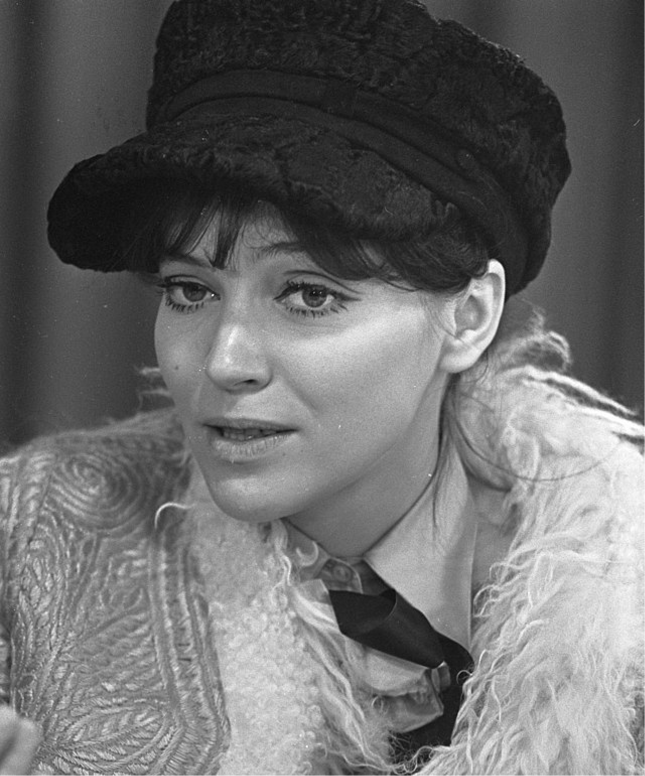
I’d rather not post a picture of myself. I know that can be frustrating for readers, so as a compromise, below I have attached two images to have in mind when you think of me. I have been told that I resemble Anna Karina. I also have a hat like hers in the photo. Her eyes are softer than mine, however. Mine are more intense, like a sloth’s. And like this rainforest mammal, I move slowly.

The Sloth Who Needs Money, or Why I Blog


Actually, I don’t want to have a blog at all. This is a compromise. What I’d really like to be doing is writing fiction.


I’ve had an atypical/ multicultural life (see “About Me”) which has been very alientating and inconvenient in many ways. However, as a result, out of necessity, I’ve learned to build bridges between cultures and viewpoints. Some think they know what critical thinking is. They may encourage it, celebrate it or even attempt to teach it. At least they try! In my life, being a critical thinker has been the key to my survival. It has offered me unique perspectives on many topics. Hence, I have a great deal to say to the world and I see fiction as the best form for it.


Creating fictional characters and storylines at the pace of a sloth wouldn’t be so bad if I had the time. But I do not. I am a mother of young children in the Western World. And the stereotpe of such a profile fits me like a glove.

Other than the desire to share my unique perspective, I am also faced with a less interesting dilemma, but an international one: the necessity of money. Why specifically? To visit my mom in the U.S.A.
One trip there, as a family, costs the equivalnet of a down payment on a small house in a blue collar suburb of a major American metropolis.

So, I asked myself: How can I combine my desire to write with my need for money considering how little time I have?

The answer I found was to start a blog about a topic that sticks to me like superglue. A topic that fills my mind and conversations on a daily basis and of which I have a regular supply needless of much effort. I will write about what it’s like to be a foreigner here in France coming from my particular viewpoint as a person who was already multicultural before they arrived (see “About Me”).

How do I hope to make money with this blog?
Yes, you guessed it, through the ads. (At least I hope that there will be ads for my own financial benefit and not just Google’s.) If there aren’t any than that means things aren’t going so well. So, when you visit this site, if you see lots of ads, despite the annoyance, please be happy for me!

Black, Blanc, Beur (Part One)

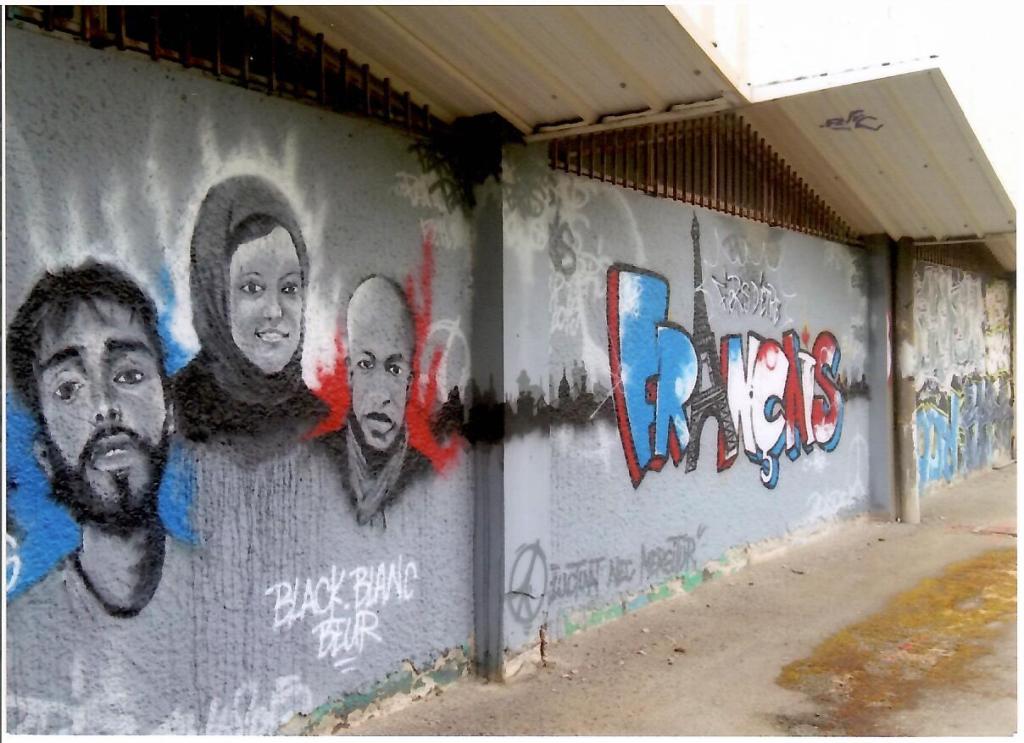
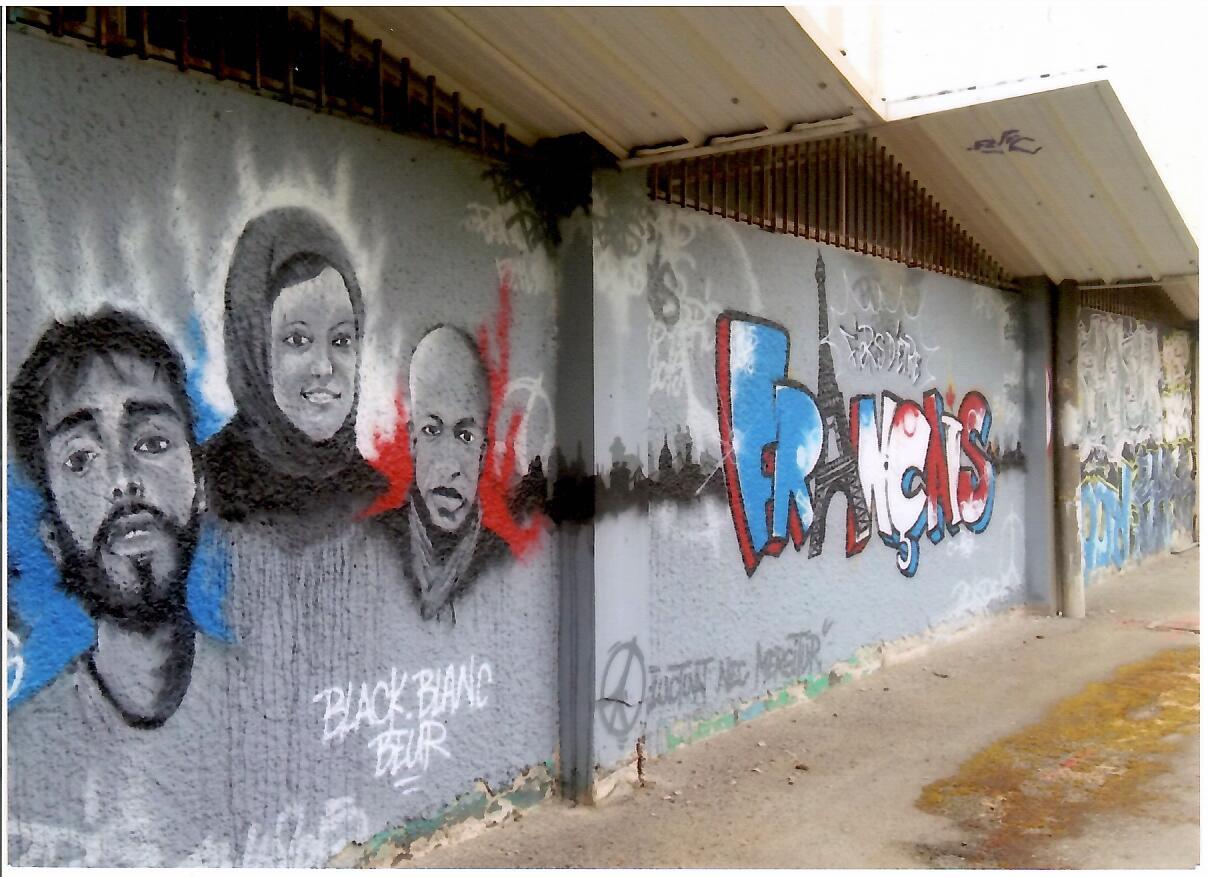
In my home country we say that “a picture is worth a thousand words.” Concerning, the above photograph, “Black, Blanc, Beur,” that expression is an understatement. When I look at it, words enough to fill an entire book fill my mind. So I can certainly fill a blog! Today, on the 25th hour of 2022, it begins.

What you see above is a photograph I took of graffiti art done on the back wall of a minimart in my neighborhood. The colors: blue, white and red were used because they are the three colors of the French flag. Did you notice the Eiffel Tower? Due to its triangle shape it was used to substitute the first “A” in the word “Français,” which translates as “French.”

We also see three young people, underneath whom, the inscription “Black, Blanc Beur” is written.
“Black,” refers to people of Sub-saharan African decent.
“Blanc,” which translates as “White,” refrers to Europeans.
“Beur,” refers to those of North African and Arab etnicity.
And, yes, those three words starting with the letter “B” refer to the ethnicities of the people painted above it. I’ll let you guess which B-word is linked to which portrait.

So why would an artist choose to combine these words and imagery?

The artist is expressing their opinion on an on-going debate in France: What does it mean to be French? This debate has nothing to do with what one’s legal documents say, like a birth certificate or passport. It is refering to the popular idea. How people in society define what it means to be French.

My personal interpretation is that the artist is saying that a person does not need to be White to consider themselves French; even though, France, a country of Europe, is populated by mostly Whites. A person can be viewed as French regardless of their ethnicity, be it Black or Blanc or Beur. (And I am sure that s/he would agree that the same goes for any other ethnic group.)

It is also important to note that this debate can include non-Whites who were born and raised here in France, as well as second generation and even farther back.

Does this debate seem strange to you? It certainly did to me when I first came to France.

My first memory of it occured on a Parisian subway car, zooming by countless walls of graffiti. I was sitting with a French friend of Arab descent, named Khadega, and a White American friend, named Melissa, who was visiting me from the U.S. Somehow the topic of racism came up. In a perfect local accent, my French-born friend said, ” I don’t identify myself as French. I don’t feel French.” Melissa and I, both born in the U.S.A., looked at eachother, puzzled. “I am German and Italian,” said Melissa, but I feel American first. “I feel, American, too,” I agreed, raising my Azeri-Iranian eyebrows and rubbing my knoby Irish knees.

It took me a long time to understand why someone who was born here and hence speaks French like any national wouldn’t identify themselves as a French person. It has taken me years actually to fully comprehend it! In the end I have come to understand that what I feel as an American is unique. Our view as a national collective is that if you were born in a country and speak like the people from that country then you are From there.

So then how is it that Khadega doesn’t feel that she is a part of the country where she was born, but I do. I am not native American, like Khadega is not native French; and yet, I feel a part of the country where I was born, but she does not.

I’ll let you reflect on that and I will continue with Part Two tomorrow. (And this topic may well reach one thousand words.)

Design a site like this with WordPress.com
Get started